
Naming the Patterns
How Evagrius Helps Us Rewrite Our Inner Scripts

During the second week of each month, I talk about “Theology in Real Life.” This is space where we can work with some theological ideas and their practical implications. This week, I take a look at a theology of temptation and resistance from a desert monk, Evagrius Pontus. Last week, I introduced Evagrius in a post on acedia that many of you appreciated. I thought you might enjoy take another peak at his thought. (By the way, a lot of this post ended up on the cutting room floor, so don’t be surprised if he makes another appearance!)

"Why do I keep doing the same [expletive] thing over and over?"
He wept, and I wept with him.This could summarize any number of conversations I’ve had – both as the one hearing the confession and the one speaking it. From person to person, the sins differ, but the ache is shared.
In those raw moments, the word of grace is what we need most. Not analysis. Not shame. Not another disappointed voice piling on. God knows we provide plenty of that to ourselves. We need is someone to speak mercy. To remind us: You are not your failure. You are not alone. You can grow.
Eventually, we need something more. Not more guilt, but more clarity. We need to name the deeper patterns. Because if we don’t know what we’re up against, we won’t know how to say yes to grace.
Why Naming Matters
Before there were the Seven Deadly Sins or modern style personality typing systems, there were desert monks naming demons. They weren’t trying to label people. They were mapping the terrain of the human soul. They noticed that temptations had patterns that showed up again and again. They also came to the conclusion that the more clearly we name them, the more clearly we can resist them and cooperate with grace. Naming the patterns and the triggers were ways of naming the wounds. When the wound is named by the sinner, it can be named to the Healer.
The Desert Mapmaker: Evagrius of Pontus
Evagrius was a 4th-century Christian monk who left a promising career in the Roman Church to seek healing in the Egyptian desert. He became one of the early architects of Christian monastic thought. Not all of his theology endured as some of his more speculative views were later rejected. However, his insights into spiritual formation have left a lasting legacy.
He was one of the early writers to identify and categorize the inner "thoughts" (logismoi) that trigger patterns of sin. His goal was peace: a heart so aligned with the kingdom of God that it was no longer ruled by chaotic passions.
Evagrius’ work is grounded in Scripture, sharpened by reason and philosophical clarity, shaped by the monastic tradition, and forged in experience. He’s doing pastoral theology long before the phrase existed. Thus, he shows how our internal landscape can become either a battleground or a sanctuary.
The Eight Spirits / Logismoi
Evagrius names eight primary tempting thoughts (logismoi) that afflict the soul:
Gluttony
Sexual immorality (porneia)
Avarice
Sadness
Anger
Acedia
Vainglory
Pride
He frames the spiritual life as a battle with demons. The demons wield these logismoi in their attempts to distract and destroy us. Part of his insight is how the logismoi do not typically come as fully ripened images of sin. They are much more subtle and often laced with a certain kind of logic.
When the thought comes, it comes as an agitation. At that point we can reject or play with it. Exorcise it or tolerate it. If we entertain it, it soon ignites a passion. The passion leads to action. The action leads to habit.
“We cannot control whether or not the thoughts come... but we can choose whether they stay and what they spark within us.”
This is where the work of naming matters most. When we fall, it’s rarely out of nowhere. Trace it back. There’s usually a subtle moment—a flicker of fear, a whisper of entitlement, a clench of control—where the logismos first entered. And we either resisted it… or let it linger.
Let’s go back to that cycle of thought to passion to action. When Evagrius speaks of passion, he is concerned with the strong even overpowering emotional drives. It is that surge of internal energy that blows through our resistances.
Psychologist Jonathan Haidt uses the metaphor of the elephant and the rider. The rider, he says, represents the rational part of us that sees the road ahead and chooses which direction to go. The elephant represents the emotional drives and energy. When there is a disagreement between the rider and the elephant, the elephant wins.
Our passions are like that. Once they get rolling they are nearly impossible to control. We slip into acting by instinct. That’s when later we look back and say things like, “Before I knew it, I was doing …”
Our passions are like that. Once they get rolling they are nearly impossible to control. We slip into acting by instinct. That’s when later we look back and say things like, “Before I knew it, I was doing …”
Evagrius’ point is that the demons that oppose us employ the tempting thoughts in an attempt to churn the passions. Once the passions are moving in the wrong direction, the human’s battle is all but lost.
Evagrius also teaches that the enemy knows our weak points. The thoughts come clothed in logic. Avarice, for instance, doesn’t begin with greed. It begins with imagining future poverty, weakness, and abandonment. These things do exist and could happen. The temptation is to do everything possible to avoid that fear. It might even sound like prudence at the time, but is really a lack of trust in God’s goodness. Thus, the temptation is shaped to seem reasonable, but is only masquerading. That’s what makes it effective.
Sometimes these spirits work together with multiple logismoi to ignite multiple passions. For example, a person overwhelmed with fear of lack will become consumed with accumulation to stave off any lack. But that kind of fear is never assuaged. There is always another potential catastrophe. Consequently, all the efforts of accumulation ultimately fall short. This causes chronic persistent sadness, which can lead to anger at being frustrated. To counter the sadness and anger, one begins to seek comfort in food or sex but is ultimately never satisfied. One spirit opens the door for another.
A Field Manual for the Soul
Evagrius doesn’t just diagnose. He offers training. Like any good spiritual director, he gives specific countermovements that are concrete practices to resist the logismoi and strengthen the soul’s capacity for grace.
He groups the challenges and responsces into three triads:
The wandering nous (mind/soul): countered by reading, vigils, prayer
Burning desire (epithumia): countered by hunger, toil, solitude
Churning anger (thumos): countered by psalm-singing, endurance, compassion
Then, he assigns specific countermovements to each logismos. Here’s a distilled version with modern scenarios:
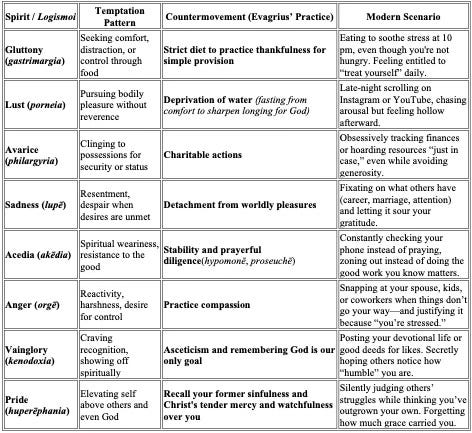
Does This Still Matter?
Some of these countermovements may seem puzzling. For example, it might be difficult to see the relationship between fasting water for strengthening chastity. Evagrius was a man of his times and speaking according to the current understanding of what we now call biology and psychology. The principle is worth attention even if some concrete expressions might not make sense.
We may not fast from water, but we understand what it means to withhold indulgence to reorder desire. We might not live in a monk’s cell, but we know the pull of the smartphone away from time with God.
Evagrius reminds us that we are not left helpless. If we listen closely, the Spirit still reveals the "way of escape" (1 Corinthians 10:13). There are ways to say no by actively participation in grace.
Rewriting the Pattern: Tools for Today
Here are some ways to consider putting this to work in your own spiritual life.
1. The Examen
St. Ignatius of Loyola required his companions to pray the Examen multiple times a day. Why? Because it’s how we train the eyes of the soul. When we name what stirred us—when we trace it to its root—we begin to reclaim our freedom. If you’ve never prayed the Examen, I’ll send a short guide and a recorded version for you to try later this week.
2. Spiritual Direction
We need someone else in the room. We all have blind spots. We are often blinded to our own weaknesses as well as our own strengths. This can create static that makes hearing the voice of God difficult. Working with a spiritual director helps bring vision to the blind spots. The result is a clearing of the static as the voice of the Lord comes forward more clearly. Having been in and practicing spiritual direction for some time now, I am more convinced than ever of the necessity of this ministry. Anyone serious about their spiritual growth would benefit from having a spiritual director. This is especially true for those who are in ministry leadership.
3. A 3-Day Challenge
Want to try this out?
For the next 3 days, pray the Examen each evening (or midday and evening).
Ask: What stirred in me today? What patterns do I notice? Where did I say yes to grace or no?
Jot a single sentence resolution for the next day: “When that logismos shows up again, here’s how I’ll respond.”
It doesn’t have to be heroic. Just real.
We don’t fight demons with drama. We fight them with grace.
We name the pattern. We resist the lie. We rewrite the story.
And God meets us in it all.
Wow! Spot on with Gluttony. I see these patterns.